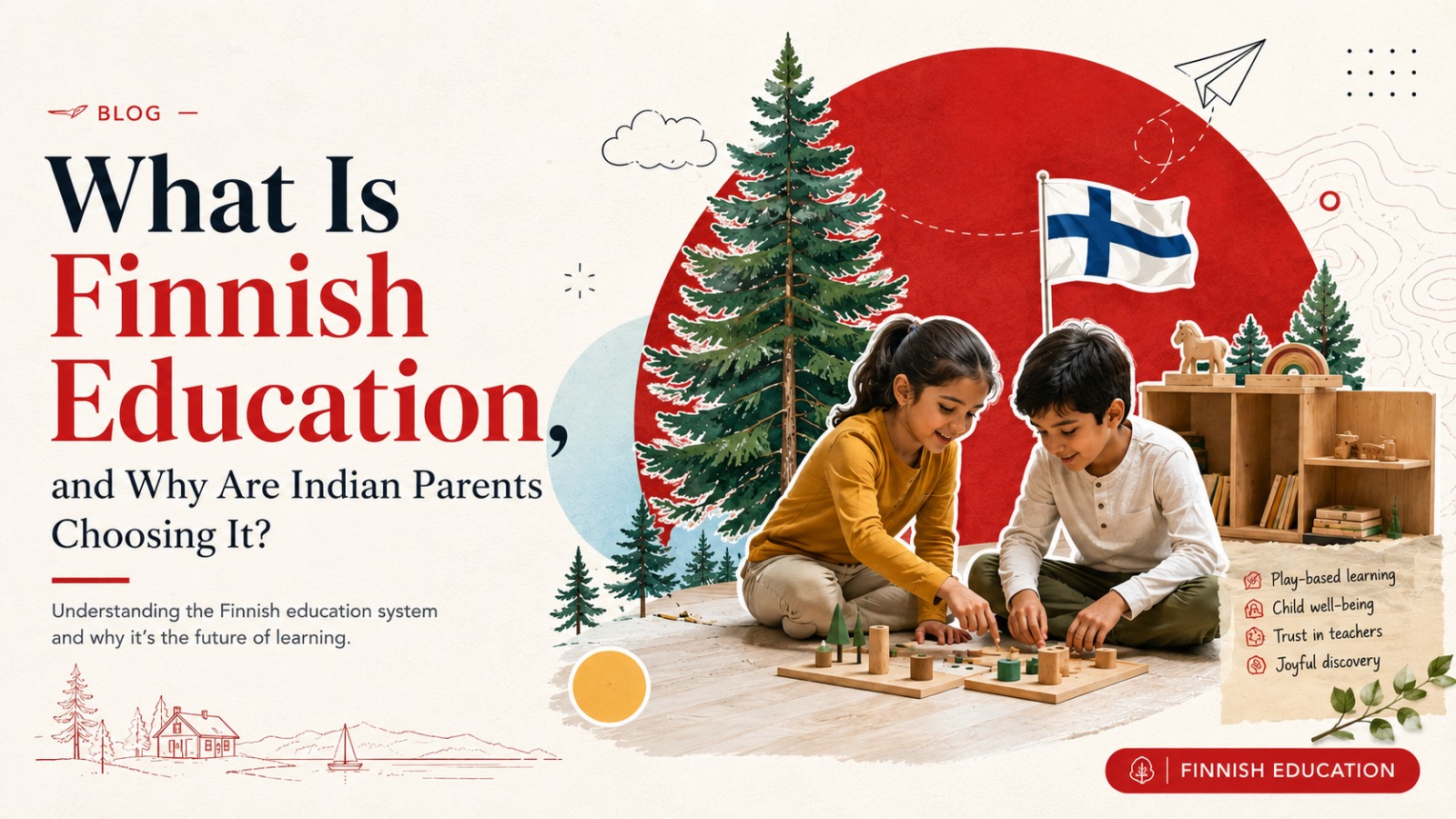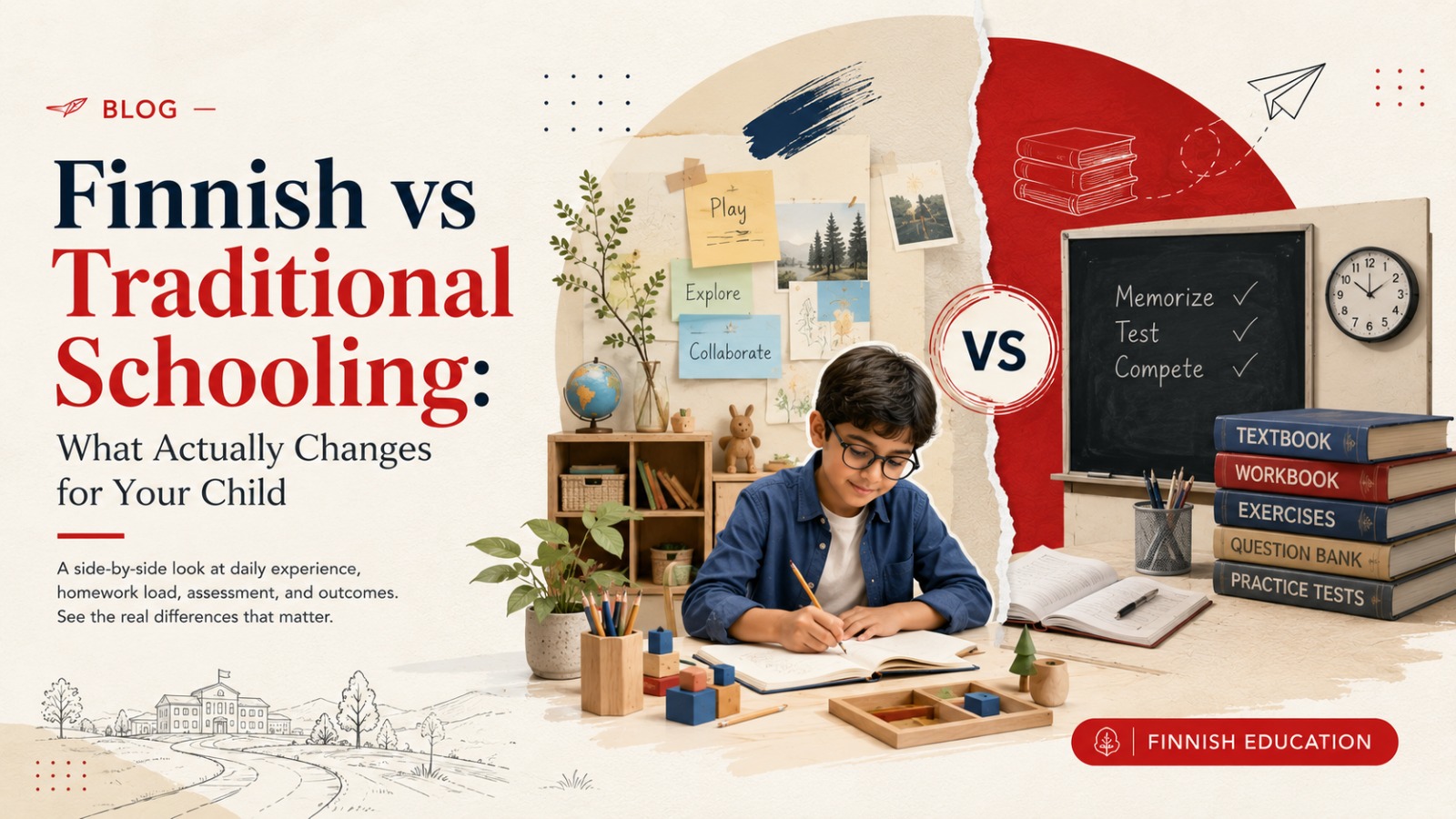
The difference between a Finnish-influenced school and a traditional one is not a matter of branding. It changes the shape of your child's day, how much homework they carry, how they are tested, and what they are like at the end of a school year. Here is what actually differs, feature by feature, so parents in Chandigarh and the Tricity can judge which suits their child.
The school day
In a traditional classroom, much of the day is spent with the whole class facing the front, working through a fixed syllabus at a fixed pace. A Finnish-influenced classroom builds in more movement, more small-group and project work, and regular breaks, because children concentrate better in shorter, active bursts than in long passive stretches. The content is not lighter. The delivery is different, and for many children it is the delivery that decides whether they stay engaged.
Homework and the evening
Traditional schooling often sends large volumes of homework home from an early age. The Finnish approach keeps early-years homework minimal, on the view that young children have already done a full day of learning and benefit more from play, family time, and rest. As children grow, homework increases, but it stays purposeful rather than heavy. For families, this often means calmer evenings and a child who is not exhausted before the next school day begins.
How children are assessed
This is where the two models diverge most sharply. Traditional schools rely on frequent tests and rankings, which can start distressingly early. A Finnish-influenced school assesses through observation, projects, and continuous feedback, reserving formal examinations for when they genuinely matter. The child still knows how they are doing, and so do you, but the constant comparison and fear are removed from the early years.
What you notice at home
Parents who move a child into a Finnish-influenced environment often report the same things: more curiosity, more willingness to attempt hard problems without fear of getting them wrong, and less anxiety about school. These are not soft extras. A child who is not afraid to be wrong learns faster, because they attempt more and hide less.
Where traditional schooling still holds appeal
It would be dishonest to pretend the traditional model has no strengths. Its structure and exam familiarity can suit children who thrive on clear targets and competition, and some parents value the predictability. The honest question is not which model is better in the abstract, but which fits your particular child. A confident, self-directed learner and an anxious perfectionist may need different things.
Making the choice
The best way to decide is to see both in action and watch how children behave, not just what is on the noticeboard. Dbels runs its Finnish Elementary School alongside a structured senior programme in Panchkula, so families can see how the early-years approach feeds into later academic rigour. Visit, observe a classroom, and ask how your child specifically would be supported. The right school is the one that matches the child, not the brochure.